

September 30, 2026
For years, capacity has been one of the defining considerations in nonhuman primate research. Sponsors needed access to the right animals, the right facilities, and an experienced team capable of executing increasingly complex studies on increasingly demanding timelines. Those things still matter, but as drug development becomes more sophisticated, capacity alone is no longer enough.
At Envol Biomedical, our growth is increasingly focused not simply on how much research we can support, but on how intelligently that research can be conducted. That means investing in technologies that improve study execution, expanding the scientific expertise surrounding each program, and connecting capabilities that have traditionally existed in separate silos.
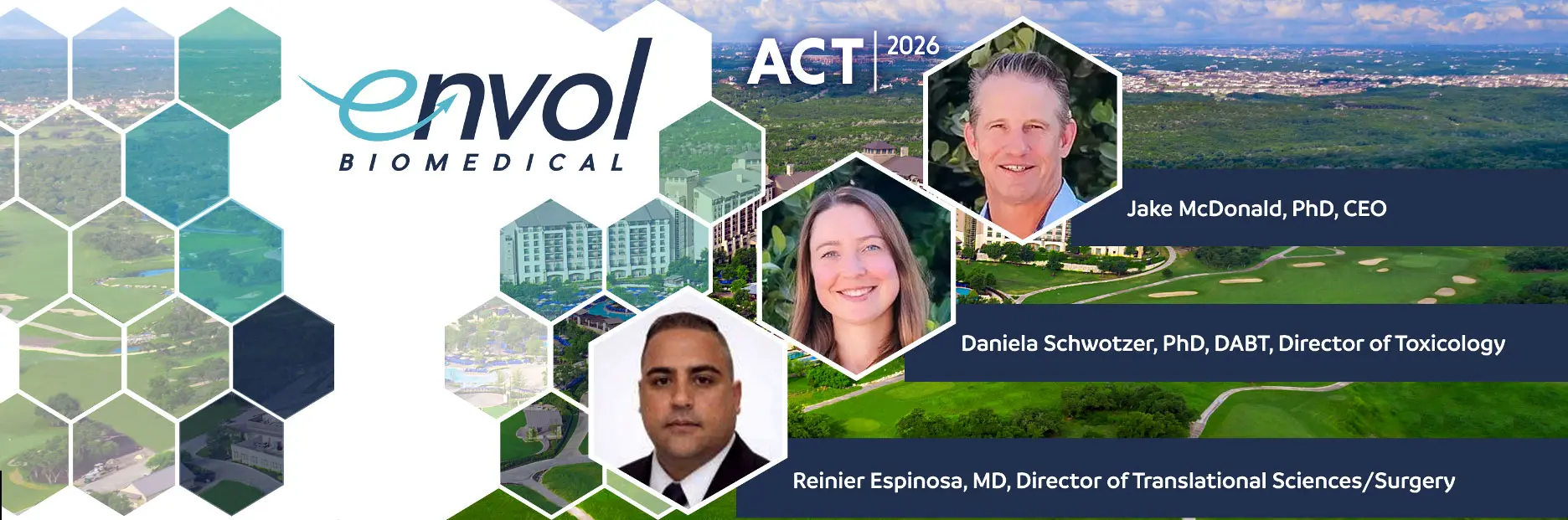
This November, the Envol team will be in San Antonio for the American College of Toxicology (ACT) Annual Meeting, where several examples of that philosophy will be on display. As a Gold Meeting Sponsor and Meeting Bag Sponsor, Envol will have a significant presence at this year’s meeting, including three scientific presentations highlighting technologies and collaborative approaches that are helping reshape nonclinical research.
Technology Should Help Answer Better Questions
The value of technology in preclinical research is not simply that a new instrument, software platform, or analytical capability exists. The real question is whether it helps researchers generate better information, make better decisions, or reduce uncertainty. That thinking has guided many of Envol’s recent investments.
Imaging, for example, has become increasingly integrated into Envol study design rather than being treated as a standalone service. Ultrasound, X-ray, fluoroscopy, MRI, PET/CT, and other imaging modalities can support everything from surgical guidance and precise dosing to disease-model characterization, safety assessment, and longitudinal evaluation of therapeutic response.
When imaging is integrated into the study from the beginning, it can provide another layer of information that helps researchers understand not only whether something happened, but when, where, and how it occurred. The same principle applies to Envol’s expanding surgical capabilities. Complex NHP programs may require targeted administration, serial sampling, catheterization, image-guided procedures, or specialized approaches to the central nervous system. Envol has continued to build the surgical expertise and supporting technologies necessary to execute these procedures with a level of precision that can open new possibilities for study design. The objective is not technology for technology’s sake. It is using the right technology to design a better experiment.
Finding Better Ways to Generate Safety Data
Telemetry provides another example of how seemingly small technological advances can have significant implications for study execution.
At ACT, Envol’s Reinier Espinosa, MD, will join emka Technologies for the exhibitor-hosted program, “Accelerating Safety Data: Higher-Throughput Toxicology Studies via Minimally Invasive Telemetry.”
The session will examine minimally invasive telemetry approaches designed to capture high-quality cardiovascular physiological safety signals while shifting from traditional intraperitoneal implants toward less invasive subcutaneous alternatives.
For Envol, advances like these represent an important part of the future of toxicology. When new technology can reduce procedural burden while continuing to generate the information researchers need, it creates an opportunity to improve both study design and efficiency.
Connecting Study Execution to the Data Behind the Decision
Generating high-quality study data is only one part of the challenge. Sponsors also need to organize, interpret, and ultimately use that information to determine what comes next. That is why Envol has continued to invest in the infrastructure surrounding its studies.
Expanded bioanalytical capabilities are helping Envol connect complex in vivo research more directly with the analytical data needed to understand therapeutic exposure and biological response. At the same time, Envol’s growing Clinical Pathology Laboratory provides an ongoing view into how an investigational therapy is affecting the biological system throughout a study.
Hematology, clinical chemistry, coagulation, urinalysis, and other clinical pathology measurements can provide important longitudinal insight into physiological response. Combined with bioanalytical data and observations generated elsewhere in a study, these capabilities help create a more complete picture of what is happening and why. The next opportunity is making those increasingly rich datasets easier to use.
Through Envol’s work with Resero Analytics, study data can be supported by modern laboratory information management and reporting infrastructure, including TurboLIMS. Structured, traceable data creates a stronger foundation not only for study reporting, but also for new approaches to analysis.
That will be the focus of another Envol presentation at ACT. Daniela Schwotzer, PhD, DABT, Director of Toxicology at Envol Biomedical, will join Dave Watson, PhD, of Resero Analytics for “From Study Execution to IND Readiness: AI-Powered Benchmarking in Nonclinical Drug Development.”
The session will explore how structured study data and AI-supported benchmarking can help study directors evaluate biological responses, place findings into a broader context, and make better-informed decisions as programs move toward IND readiness.
AI is most valuable when it is built upon reliable data. For Envol, that means the work begins long before an algorithm analyzes a result. It begins with how a study is designed, how information is collected, how samples are analyzed, and how data are structured and maintained.
Building More Integrated Development Strategies
Technology also becomes more powerful when expertise from multiple disciplines can be brought together around a development problem. That philosophy will be reflected in Envol’s third presentation at ACT, “Roadmap for Integrated Pharmacology, Tolerability, and Immunogenicity Studies of mRNA-LNPs.”
Jake McDonald, PhD, CEO of Envol Biomedical, and Syed Reza, MD, of NOF will discuss integrated strategies for LNP development that connect physicochemical characterization with in vitro and in vivo toxicology and translational screening.
The goal is a familiar one across all of these technology investments: generate the right information earlier so sponsors can make more confident decisions about which candidates should continue moving forward.
For increasingly complex modalities such as mRNA-LNP therapeutics, no single technology or capability provides every answer. Progress depends upon connecting formulation, characterization, pharmacology, toxicology, analytical science, and biological interpretation into a development strategy that makes sense as a whole.
Moving Beyond a Collection of Capabilities
This is ultimately where Envol’s approach to growth is heading. Imaging is more useful when it informs surgery and longitudinal assessment. Advanced surgical capabilities are more valuable when they can be incorporated into carefully designed pharmacology and toxicology programs. Bioanalysis and clinical pathology become more powerful when their data are integrated with observations from the study. Modern data infrastructure creates opportunities to use that information in new ways. AI-supported analysis becomes more meaningful when the underlying data are structured, traceable, and scientifically sound.
Together, these capabilities can create something much more valuable than a longer list of services. They create a more integrated preclinical research platform. That evolution is particularly important as Envol continues to expand its toxicology programs and GLP capabilities. Modern regulated studies demand scientific expertise, quality systems, data integrity, specialized infrastructure, and the ability to bring all of those elements together without creating unnecessary operational friction for sponsors. Envol has been investing in each.
See What’s Next for Envol at ACT 2026
The ACT Annual Meeting provides an ideal opportunity to bring these developments together. Members of Envol’s scientific and business development teams will be in San Antonio throughout the meeting to discuss the company’s expanding GLP capabilities, advanced NHP research platform, technology investments, and the increasingly integrated approach Envol is taking to preclinical drug development.
And through three exhibitor-hosted scientific programs, attendees will have an opportunity to see specific examples of that approach in action, from minimally invasive telemetry and AI-supported nonclinical analysis to integrated development strategies for mRNA-LNP therapeutics.
Envol Biomedical is proud to participate as a Gold Meeting Sponsor and Meeting Bag Sponsor, and we look forward to connecting with colleagues, collaborators, and sponsors from across the toxicology community. If you will be attending ACT 2026 in San Antonio, come meet the Envol team and discover why the next stage of our growth is about much more than capacity. It is about what we can help you accomplish with it.