

September 18, 2026
The development of new drug delivery approaches often depend on answering a deceptively simple question: Can a promising formulation deliver the right amount of drug, through the right route, with a pharmacokinetic profile that supports its intended use? A recently published study co-authored by Envol Biomedical Director of Toxicology Daniela Schwotzer, DABT, provides an excellent example of how nonhuman primate research can help answer that question.
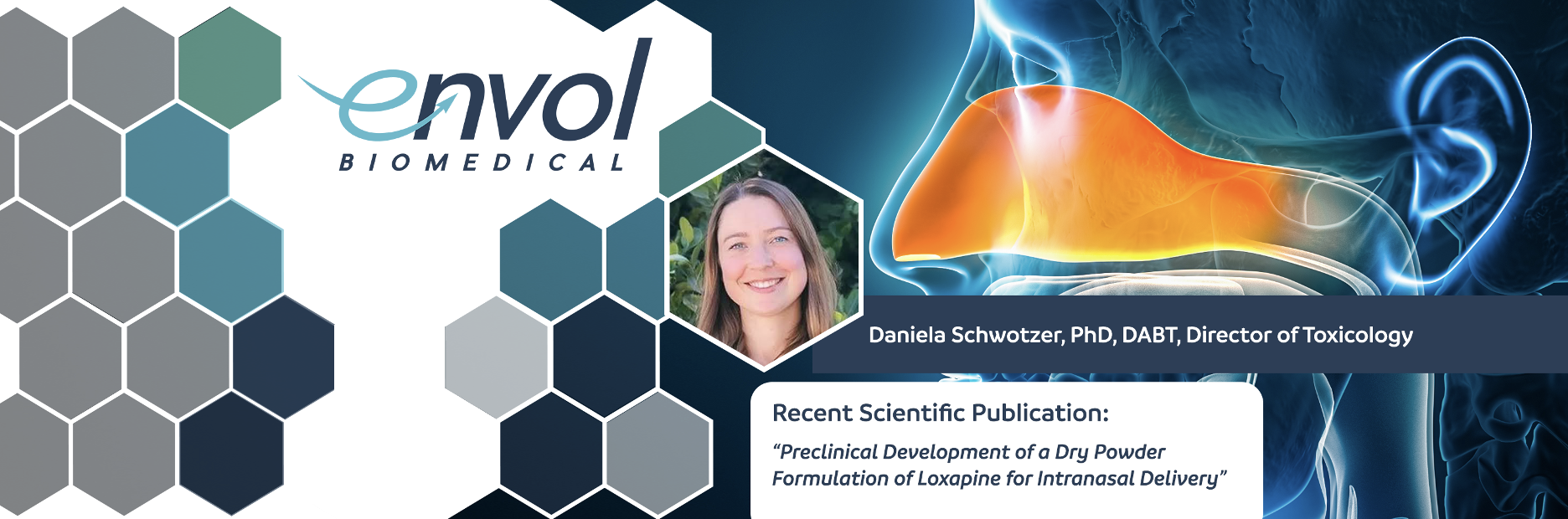
The publication, “Preclinical Development of a Dry Powder Formulation of Loxapine for Intranasal Delivery,” describes the preclinical evaluation of dry powder formulations of loxapine designed for intranasal administration. The research included work conducted while Schwotzer was at Lovelace Biomedical, prior to joining Envol Biomedical.
For Envol customers, however, the publication represents more than an important contribution to the scientific literature. It highlights the depth of experience Schwotzer now brings to Envol as the company continues expanding its toxicology capabilities and explores opportunities to support increasingly sophisticated inhalation and intranasal programs.
Exploring a New Route for a Known Therapeutic
Loxapine is an antipsychotic drug, and the research described in the publication focused on developing a dry powder intranasal formulation that could potentially provide a practical approach for treating acute agitation associated with psychiatric conditions such as schizophrenia and bipolar disorder.
The potential advantage of intranasal administration is particularly compelling in applications where rapid and convenient delivery may be important. Rather than relying exclusively on treatment approaches requiring administration within a clinical setting, an effective intranasal formulation could ultimately offer another avenue for delivering therapy. Getting from that idea to a viable drug product, however, requires considerably more than simply placing an existing compound into a new delivery device.
Different formulations can produce very different exposure profiles. Researchers therefore need to understand how efficiently a formulation delivers the compound, how quickly it enters systemic circulation, how concentrations change over time, and whether exposure reaches levels appropriate for the intended therapeutic application. That is where carefully designed preclinical studies become critical.
Using NHP Research to Compare Intranasal Formulations
As part of the development program, multiple formulations were evaluated to determine which demonstrated the most promising characteristics for continued development.
According to Schwotzer, the nonhuman primate portion of the work provided an opportunity to examine the pharmacokinetic behavior of the formulations following intranasal administration.
After administration, blood samples collected over time allowed researchers to evaluate how circulating concentrations of loxapine developed and changed. These data helped the research team compare formulations and determine whether exposure was consistent with the levels needed to support the drug’s intended application. One formulation emerged as particularly promising.
“The formulation gave us what we needed in terms of kinetics,” Schwotzer explained. “That gives the sponsor the information they need to determine whether they can move forward with that formulation and potentially advance it toward human studies.”
The NHPs also tolerated the administration well during the work conducted by the Lovelace team, providing another important piece of information as the formulation was evaluated for further development.
Specialized Experience Matters in Inhalation and Intranasal Studies
Studies involving inhaled or intranasally delivered compounds introduce challenges that can differ substantially from more conventional routes of administration.
Study design must account not only for the test article itself, but also for formulation characteristics, delivery methodology, dosing procedures, sample collection, pharmacokinetic endpoints, animal handling, and the practical realities of consistently administering a product through the respiratory or nasal route. That combination makes prior hands-on experience especially valuable.
“I know how to run inhalation studies in nonhuman primates. I have done a lot of these,” Schwotzer said. “I’m the right person to set up these studies, and I can teach my team of study directors how to run them so they can learn from my experience.” That transfer of experience is an important part of Schwotzer’s role at Envol.
As Director of Toxicology, she is not simply bringing her own scientific background to individual programs. She is helping build that knowledge into Envol’s broader toxicology organization by mentoring study directors, helping establish study approaches, and expanding the types of programs the team can confidently support.
Bringing Inhalation Expertise to Envol
Envol has continued to expand its scientific infrastructure and NHP research capabilities to meet increasingly complex sponsor needs. Schwotzer’s experience creates an opportunity to build upon those resources in areas such as inhalation and intranasal drug development. The recently published loxapine work illustrates the type of program her experience can help support.
A sponsor developing an inhaled or intranasal therapeutic may need to compare formulations, characterize systemic exposure, evaluate tolerability, establish pharmacokinetic profiles, or generate the preclinical data necessary to make a confident decision about which candidate should move forward.
These programs require more than access to NHPs. They require scientists who understand how to translate a development question into an executable study and recognize what the resulting data need to tell the sponsor. Schwotzer brings that experience to Envol.
Combined with Envol’s growing NHP capabilities, scientific team, and supporting infrastructure, her background provides another avenue through which the organization can help sponsors address specialized preclinical development challenges.
Building Capability Through Scientific Leadership
Scientific capability is ultimately built around people. Facilities, equipment, animal models, and technology are essential, but experienced scientists are what turn those resources into studies capable of answering meaningful development questions.
The publication of “Preclinical Development of a Dry Powder Formulation of Loxapine for Intranasal Delivery” is one example of the experience Schwotzer has accumulated throughout her career. More importantly for Envol customers, that experience did not remain with her previous organization. It came with her.
Today, Schwotzer is applying that background as Envol’s Director of Toxicology, helping strengthen the company’s toxicology organization, develop its study directors, and broaden the range of sophisticated NHP programs Envol can support.
For sponsors investigating novel formulations and alternative delivery routes, that means access not only to Envol’s growing research capabilities, but also to scientific leadership informed by experience conducting the kinds of studies that move promising therapies toward their next development milestone.