

October 10, 2026
Three scientific presentations by the team from Envol Biomedical will highlight advances in minimally invasive telemetry, AI-powered nonclinical data analysis, and integrated approaches to evaluating emerging mRNA-LNP therapeutics.
As the pharmaceutical and biotechnology industries continue to pursue more efficient, predictive, and scientifically rigorous approaches to drug development, the need for innovative preclinical research strategies has never been greater. From improving the quality and efficiency of safety assessments to integrating advanced technologies and making better use of complex study data, the future of nonclinical research depends on combining scientific expertise with practical innovation.
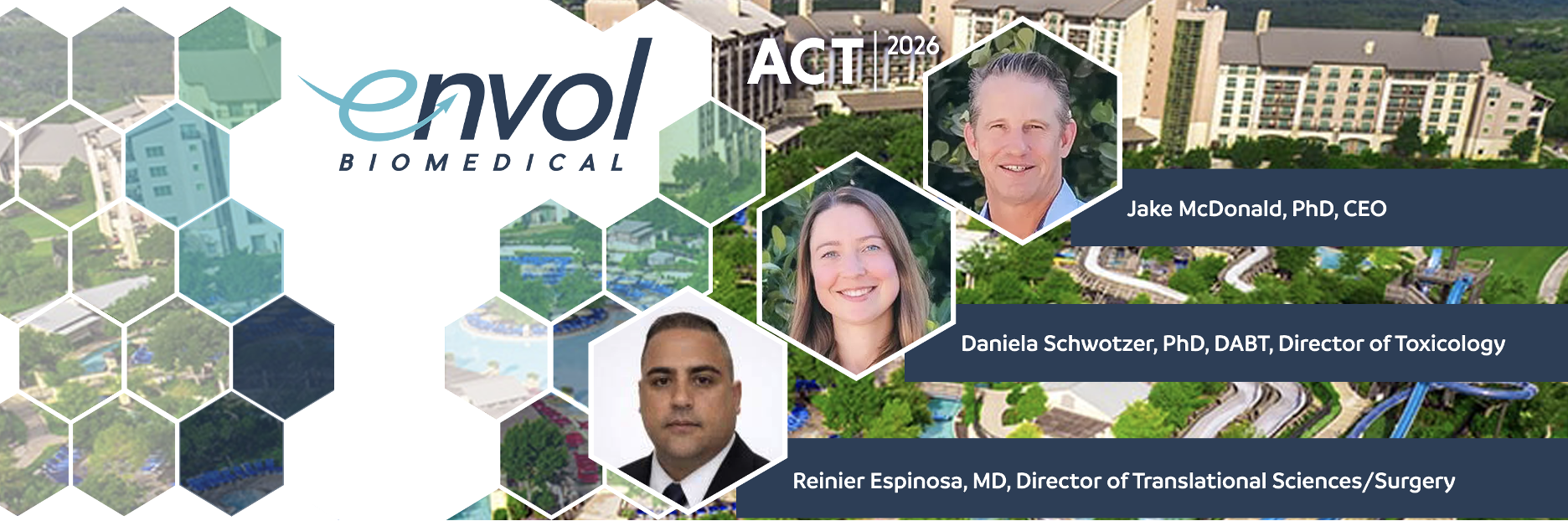
At the 2026 Annual Meeting of the American College of Toxicology (ACT), Envol Biomedical will contribute to these important conversations through three scientific presentations featuring members of its leadership and scientific teams. Together, these presentations reflect Envol’s commitment to advancing preclinical research through new technologies, integrated study designs, and collaborative scientific problem-solving.
The presentations will explore three areas of growing importance to drug developers: minimally invasive telemetry for more efficient toxicology studies, artificial intelligence and structured data for improved nonclinical decision-making, and integrated strategies for evaluating the safety and performance of mRNA lipid nanoparticle (LNP) therapeutics.
For attendees interested in the intersection of scientific innovation, operational efficiency, and regulatory readiness, these sessions offer an opportunity to explore how emerging approaches can help address some of the industry’s most pressing development challenges.
Advancing Cardiovascular Safety Assessment Through Minimally Invasive Telemetry
Presentation: Accelerating Safety Data: Higher-Throughput Toxicology Studies via Minimally Invasive Telemetry
Presenter: Reinier Espinosa, MD, Envol Biomedical
Monday | 12:00–12:55 PM | Grand Oaks Ballroom N
Cardiovascular safety assessment remains an essential component of nonclinical drug development. However, traditional approaches to collecting cardiovascular data can introduce operational complexities, require invasive procedures, and limit the flexibility with which studies can be designed and executed.
As drug developers seek opportunities to generate more meaningful safety data while reducing procedural burden and improving study efficiency, advances in minimally invasive telemetry offer an important opportunity.
During this presentation, Dr. Reinier Espinosa will explore how newer telemetry approaches can support higher-throughput toxicology studies while maintaining the scientific quality necessary for informed safety assessments.
Telemetry technologies allow researchers to collect physiological measurements, including cardiovascular parameters, over time. By incorporating minimally invasive approaches into appropriate study designs, researchers may be able to reduce the impact of instrumentation, support animal welfare, and improve the efficiency of longitudinal data collection.
These capabilities have important implications for nonhuman primate research, where thoughtful study design, careful resource utilization, and high-quality physiological monitoring are especially valuable.
The presentation will also examine how advancements in telemetry can support the principles of the 3Rs: Replacement, Reduction, and Refinement. Improving the ability to collect meaningful data from well-designed studies can create opportunities to refine procedures and make more effective use of available research resources.
For sponsors, the broader opportunity extends beyond the technology itself. More efficient safety assessments can support better study planning, improve access to actionable data, and potentially reduce bottlenecks in nonclinical development.
At Envol Biomedical, Dr. Espinosa’s expertise in translational research, advanced surgical techniques, and specialized nonhuman primate models contributes to the company’s ability to develop sophisticated study designs that address increasingly complex scientific questions. His presentation reflects Envol’s continued focus on applying practical innovation to improve the quality and execution of preclinical research.
Transforming Nonclinical Data into Better Development Decisions with AI
Presentation: From Study Execution to IND Readiness: AI-Powered Benchmarking in Nonclinical Drug Development
Presenters: Daniela Schwotzer, PhD, DABT, Envol Biomedical, and Dave Watson
Monday | 12:00–12:55 PM | Grand Oaks Ballroom O
Nonclinical drug development generates tremendous volumes of information, from clinical pathology and bioanalytical results to toxicological observations, pharmacokinetic measurements, and historical study data. Yet the value of this information depends on how effectively it can be organized, interpreted, and applied to development decisions.
For many organizations, the challenge is no longer simply generating sufficient data. It is ensuring that the information collected throughout a development program can be used efficiently to identify meaningful trends, assess risk, and support the decisions necessary to advance toward an Investigational New Drug (IND) application.
During this presentation, Envol Biomedical’s Director of Toxicology, Dr. Daniela Schwotzer, and co-presenter Dave Watson will examine the potential for AI-powered benchmarking to improve the way nonclinical information is evaluated and translated into actionable scientific insight.
A central consideration is the importance of structured, accessible data. When information is captured consistently and organized within a reliable digital infrastructure, it becomes more useful for comparative analysis, historical benchmarking, and the identification of patterns that might otherwise be difficult to recognize.
Technologies such as TurboLIMS, combined with advanced analytical approaches, can help establish the data foundation necessary to support more sophisticated evaluation of nonclinical study results.
AI-supported benchmarking represents a particularly promising application. By comparing emerging study results with relevant historical datasets, researchers may be able to identify unexpected findings earlier, better contextualize toxicological observations, and strengthen the scientific basis for development decisions.
These approaches are not intended to replace experienced toxicologists or the scientific judgment required to interpret complex biological findings. Rather, they offer opportunities to make that expertise more effective by providing better-organized information and additional analytical perspectives.
For sponsors preparing for IND-enabling studies, this could translate into more informed program planning, clearer identification of potential development risks, and stronger alignment between study execution and regulatory objectives.
Dr. Schwotzer brings extensive experience in toxicology, study design, and the interpretation of complex nonclinical findings to her role at Envol Biomedical. Her scientific leadership is an important part of the company’s commitment to providing sponsors with the expertise needed to navigate challenging development programs.
By exploring the integration of structured data, advanced analytics, and experienced scientific interpretation, this presentation will demonstrate how the future of toxicology may increasingly depend on the ability to turn complex information into better decisions.
Developing an Integrated Roadmap for mRNA-LNP Safety and Performance
Presentation: Roadmap for Integrated Pharmacology, Tolerability, and Immunogenicity Studies of mRNA-LNPs
Presenters: Jacob McDonald, CEO, Envol Biomedical, and Syed Reza
Tuesday | 12:00–12:55 PM | Grand Oaks Ballroom P
Messenger RNA therapeutics and lipid nanoparticle delivery technologies have opened significant new possibilities across vaccines, therapeutic proteins, gene-based medicines, and other emerging treatment modalities. However, the complexity of these platforms creates important challenges for researchers responsible for evaluating their pharmacological activity, tolerability, immunogenicity, and overall development potential.
Unlike traditional small-molecule therapeutics, mRNA-LNP products combine a biologically active nucleic acid with a delivery system that can influence tissue distribution, cellular uptake, immune responses, and safety outcomes.
Successfully advancing these products requires a development strategy that considers the interactions between formulation characteristics, biological activity, and potential adverse effects.
In this presentation, Envol Biomedical CEO Jacob McDonald and co-presenter Syed Reza will discuss an integrated roadmap for evaluating mRNA-LNP candidates, emphasizing the importance of connecting physicochemical characterization, in vitro testing, in vivo pharmacology, toxicology, and immunogenicity assessment.
One of the central challenges in mRNA-LNP development is determining how formulation attributes influence biological performance. Differences in lipid composition, particle characteristics, encapsulation efficiency, and other parameters can affect delivery efficiency, tolerability, and immune activation.
A coordinated evaluation strategy can help developers understand these relationships earlier in the development process, providing a stronger scientific foundation for candidate selection and subsequent nonclinical studies.
The presentation will explore how complementary analytical and biological assessments can be integrated to create a more comprehensive understanding of candidate behavior.
In vitro models can provide early insight into biological activity and potential cellular responses, while carefully designed in vivo studies can help characterize pharmacological effects, systemic tolerability, tissue responses, and immunogenicity.
By connecting these different sources of information, researchers can build a more complete picture of the opportunities and risks associated with individual candidates.
For sponsors, this integrated approach can offer meaningful advantages. Earlier identification of formulation-related challenges, a more comprehensive understanding of safety signals, and better coordination between development activities may help reduce uncertainty as programs advance.
The presentation also reflects an important aspect of Envol Biomedical’s broader philosophy: effective preclinical development requires more than executing individual studies. It requires understanding how each scientific activity contributes to the larger development strategy.
Under McDonald’s leadership, Envol continues to emphasize the combination of scientific expertise, advanced capabilities, and strategic collaboration to help sponsors address complex development challenges. As emerging therapeutic modalities create new demands for preclinical research, this integrated perspective becomes increasingly valuable.
Three Presentations, One Commitment to Better Preclinical Research
Although these three presentations address different scientific challenges, they share a common theme: the future of nonclinical development will be shaped by the ability to generate better data, interpret it more effectively, and apply it to smarter development decisions.
Minimally invasive telemetry offers opportunities to improve physiological monitoring and study efficiency. AI-supported benchmarking can help researchers extract greater value from increasingly complex datasets. Integrated pharmacology, tolerability, and immunogenicity strategies can provide a more complete understanding of emerging therapeutic technologies.
Each of these approaches reflects the importance of bringing scientific expertise and technological innovation together.
For Envol Biomedical, that philosophy extends across its broader portfolio of nonclinical research capabilities, including nonhuman primate toxicology, pharmacokinetics and pharmacodynamics, advanced surgical models, imaging, bioanalysis, clinical pathology, and specialized drug delivery approaches.
Envol’s scientific and operational teams work collaboratively to design and execute studies that address the specific needs of each development program. This includes the integration of advanced research technologies, experienced Study Directors, and supporting laboratory capabilities to help sponsors obtain meaningful data while navigating complex scientific and regulatory requirements.
The company’s continued investment in scientific leadership, research infrastructure, and technology-enabled approaches reflects its commitment to delivering high-quality preclinical research in an increasingly demanding development environment.
Importantly, innovation does not always mean introducing an entirely new technology. It can also mean finding better ways to connect existing capabilities, refine study designs, improve communication, and help sponsors make more informed decisions throughout the development process.
That practical, science-driven approach is central to Envol Biomedical’s participation at ACT 2026.
Connect with Envol Biomedical at ACT 2026
The ACT Annual Meeting provides an important forum for toxicologists, pharmaceutical researchers, biotechnology innovators, and nonclinical development professionals to exchange ideas and explore the technologies and strategies shaping the future of drug safety assessment.
Envol Biomedical looks forward to participating in these conversations and sharing the expertise of its scientific and leadership teams. Attendees are encouraged to join Dr. Reinier Espinosa, Dr. Daniela Schwotzer, and CEO Jacob McDonald for their respective presentations and connect with the Envol team throughout the meeting to discuss opportunities for collaboration.
Whether your program involves traditional toxicology, specialized nonhuman primate models, emerging therapeutic modalities, or the integration of advanced technologies into nonclinical research, Envol Biomedical offers the scientific expertise and research capabilities to help move development programs forward.
We look forward to seeing you at ACT 2026 and discussing how scientific leadership, innovation, and collaboration can help advance the next generation of therapeutics.
To learn more about Envol Biomedical’s preclinical research capabilities or arrange a meeting with our team during ACT 2026, contact us today.